Dismantling & Assembly of a Siler Flintlock
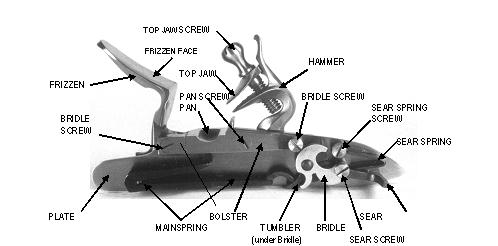
For your convenience I have included a picture of a Siler flintlock below.
Disassembly: Rotate the hammer into the fully cocked position. Using a mainspring vice, just snug the vice down on the mainspring - do not tighten! Trip the sear (releasing the pressure on the mainspring) and "wiggle" the mainspring out.
NOTE: The upper leg of the mainspring fits into a notch up under the bolster and has a post that sits in a hole in the lock plate. "Wiggle" the mainspring out by slightly rotating the spring and vice up and down (or towards and away from you) until the top of the spring comes out of the notch in the bolster, then pull outward to clear both the tumbler and to remove the post from the hole in the lock plate. Take care not to dislodge the vice from the mainspring since suddenly releasing the tension on the spring could cause it to break.
Once the mainspring has been removed, release the tension on the mainspring by unscrewing and removing the vice. Next loosen the sear spring screw about 1 to 2 turns and push the sear spring away from the lock plate. When it "pops" out of its slot finish removing the screw and spring. Remove the bridle and sear screws along with the bridle and sear. Carefully remove the fly from the tumbler and bag it to prevent its loss. At this point, only the tumbler should be left on the inside lock plate face. Finally, remove the hammer and tumbler. This is best accomplished by turning the lock over and removing the hammer screw. Place the lock on a partially opened vice, inside face down, so that the jaws of the vice are open slightly wider than the tumbler, and the lock plate is sitting flat on the top of the jaws. Using a pin punch that is smaller than the hammer screw (allowing the punch to reach the bottom of the threaded hole in the tumbler), lightly tap on the punch to drive the tumbler out of the hammer and out of the lock plate.
Complete the disassembly by removing the frizzen, frizzen spring and pan. Start by shutting the frizzen on the pan. Using the mainspring vice, slightly compress the frizzen spring just to remove the tension on the frizzen. Remove the frizzen spring screw and the frizzen spring. Carefully release the tension on the spring. Turn the lock over and remove the frizzen screw, which will release the frizzen. Remove the pan screw and the pan. Disassembly is now complete!
Assembly: Install the pan and the pan screw. Align the frizzen and install the frizzen screw. With the frizzen closed, set the frizzen spring so that one end is in the hole in the lock plate and the other against the bottom of the frizzen. Place the frizzen screw through the hole in the spring, then rotate the spring upwards until the screw aligns with the hole in the lock plate and tighten the screw. If the frizzen spring is too strong to manually align it, the mainspring vice may be used to compress the spring. Insert the tumbler through the hole in the lock plate and insert the fly into the tumbler. Use a little grease on the fly to hold it in place. Fit the bridle over the top of the tumbler and loosely install the bridle screw. Rotate the tumbler until the mainspring ledge is low (like in the picture) then slide the sear underneath the bridle and align the hole in the sear with the hole in the bridle. Install and tighten the sear screw and tighten the bridle screw. Install the sear spring and sear spring screw. Slightly tighten the sear spring screw, then rotate the sear spring down against the sear and it will "pop" into the alignment slot. Completely tighten the sear spring screw. Verify that all of the screws on the inside face of the lock are tight. Flip the lock over and align the hammer with the square shaft on the tumbler with the hammer in the forward position. Press down on the hammer until the hammer contacts the shoulder on the tumbler shaft. A nylon hammer may be used to gently tap the hammer into place. Install the hammer screw. Finally, using the mainspring vice, carefully compress the mainspring until it just fits between the bolster and tumbler ledge and press the spring into place. Pull the hammer into the fully cocked position to remove the tension from the mainspring vice, and remove the vice. Operate the lock several times to ensure that all pieces move smoothly.